
Wuthering Waves launch review highlights Kuro Games' ambitious vision and technical issues, from login errors to localization flaws.
It began not with a gentle breeze, but with a storm. I remember the morning of May 23, 2024—the day the gates of Solaris-3 finally swung open to the world. There was no trumpet fanfare, only the flicker of a loading screen and a prayer whispered to dormant servers. I was poised to walk into a world that promised echoing beauty and symphonic combat, yet the first notes I heard were fragmented, a dissonant overture to an unforgettable journey.
Kuro Games had woven a tapestry of high anticipation, and on that maiden day, countless souls rushed the threshold. We were adventurers armed not only with swords but with patience, as the very fabric of this new reality quivered under the strain. Login Timeout—those two words became a haunting refrain, a gatekeeper that would not yield. My fingers tapped restlessly, each retry a heartbeat, until the screen finally surrendered its light.
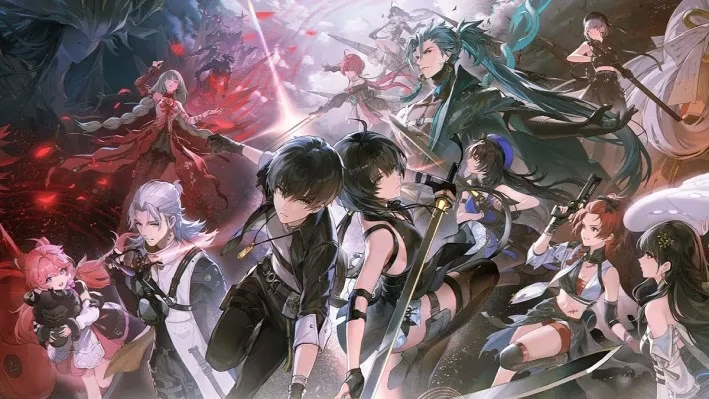
What awaited beyond was a landscape of stark contradictions. There were moments of breathtaking wonder—the way sunlight fractured through clouds over a ruined city, the fluid dance of a Resonator mid-combo—yet they were pierced by jagged edges. My phone, a loyal companion of many digital quests, suddenly faltered. The night mode, a sanctuary for my weary eyes, became a labyrinth when age authentication challenged me like a troll under a bridge. In that darkened interface, the verification window refused to cooperate, a glitch born from an overlooked harmony between guardian systems and visual comfort.
Then came the deeper tremors. For those on Samsung devices carrying the Exynos heart, the game stuttered like a wounded bird. Unreal Engine 4, the architectural genius behind the world’s beauty, kept sending crash reports—white flags raised in surrender. Each unexpected closure felt like a chapter ripped from a book mid-sentence, leaving me suspended in narrative limbo. Even on PC, a strange quirk persisted: every time the client closed, I was cast out like a stranger, forced to prove my identity anew as if the realm had no memory of my footsteps. Kuro Games later clarified this was not a bug but a clumsy UI embrace, a door that shut too eagerly and forgot to keep the latch warm.
Of all the phantom aches, the localization wounds cut deepest. Dialogues meant to be lissome and poetic stumbled forth in clunky garb. Words tangled like threadbare yarn, and exposition drooped heavily like wet silk. I wandered through a story that felt, at times, like a masterpiece viewed through a foggy lens—its soul visible but its voice muffled by a hasty translation. The community rose in a clamor, sharing screenshots on X and Reddit where mighty warriors were rendered with clay-like facades, and once-majestic landscapes dissolved into murky textures. It was the visual equivalent of a song with missing instruments.
Yet, in the eye of this cyclone, a remarkable thing bloomed. Kuro Games did not retreat into silence. On that same day, a message rose—an acknowledgment, an apology, and a promise, all woven together. Ten Lustrous Tides would drift to us on May 24th, a morning gift to soothe tempestuous spirits. More than the currency, it was the gesture that mended the frayed edges of trust. They listed every known wound: the login errors, the authentication specters, the crash prompts, the Samsung peculiarities, the PC re-login hiccup, and the localization missteps that turned poetry into prose. The transparency felt like a lantern held high in the dark.
I recall stepping away from the screen that evening, staring at a sky that mirrored the game’s turmoil. The world of Wuthering Waves was new, raw, trembling on uncertain legs. But I had seen glimmers of what it could become. The fluidity of its combat, when it worked, was a sonnet. The world design sang with a desolate grace. I understood then that some masterpieces are born prematurely, requiring a season of calibration before they can breathe at full depth.
Two years have passed since that chaotic dawn. I still wander those shores, now stable and polished, and I smile at the memory of the launch as one smiles at an old scar. The game that once creaked under its own ambition now strides with quiet confidence. Yet I hold that first day close—a reminder that even unfinished symphonies can stir the soul, and that every tempest, once weathered, leaves behind a clearer sky.
Looking back, I am grateful for the shared struggle, for the raw honesty of the developers, and for a player community that voiced its frustrations not out of malice, but out of a desire to see a dream fully realized. In those early crashes, I saw a team scrambling to catch starlight in a sieve, and I chose to wait with them. Now, as I glide over glowing plains, I feel the echo of that first login’s electricity—a spark that time has softened into a quiet, radiant burn.